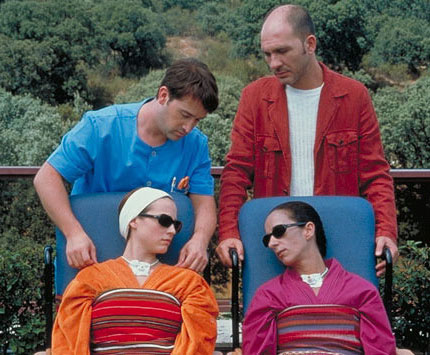
courtesy of OFFOFFOFF.com film review.
"Hable con ella"(Spanish for "Talk to Her") was released in 2002 and it was given fantastic reviews from editors all around the world. The film was chosen by "Telerama"(France) as one of the top ten movies of the year. Writer and Director Pedro Almodovar is an exquisite film maker and with his talent he creates all of his movies with at least one character who is the opposite of there socially acceptable part. "His films are always populated, at least in part, by unusual characters (transvestites, bondage freaks, pregnant nuns) who are so fully developed as characters that they seem no stranger than your next door neighbor." Said Rob Blackwelder in a review of the film. This type of character in films is somewhat rebellious to the expected, socially acceptable characters we see in most films today. In 1999, Almodovar won an Oscar for his directorial performance in "All About My Mother" because of its complex character development, it's no different in "Talk to Her". He uses flashbacks to tell you more about the emotionally ill characters and gives you so much detail, if you want it or not, about there lives. The awkward humor throughout the movie, sometimes hard to tell when, gives the audience a break from the serious nature of the plot, making the film more enjoyable to all types of viewers. In it's own time the general public (U.S.) would probably dislike the moral issue being toyed with and used as satirical humor for those complex enough to look passed it and more into the real plot of the film, mostly critics. In today's society this motion picture would be realized as a sad, hilarious, but quite possibly true story that would make audiences rethink the moral values they live by. If you followed any of Almodovar's previous movies you will notice he begins one movie where he ended the other. For example, in "All About My Mother" the credits rolled with a curtain from a the Lara Theater in Madrid and in "Talk to Her" the beginning credits start with that same curtain, essentially beginning where he left off. The play "Cafe Muller" which also ended "All About My Mother" is shown in the beginning sequence is suppose to represent the 'blind' women, or women in a coma, that will be introduced later in the film. In all instances it is hard to find someone who viewed the movie and was not emotionally touched by it or engrossed in its complex characters.


