Tucker's ART OF FILM blog

Wednesday, October 31, 2007

Journal # 3


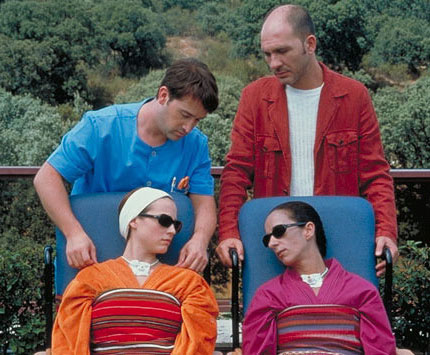
courtesy of OFFOFFOFF.com film review.

"Hable con ella"(Spanish for "Talk to Her") was released in 2002 and it was given fantastic reviews from editors all around the world. The film was chosen by "Telerama"(France) as one of the top ten movies of the year. Writer and Director Pedro Almodovar is an exquisite film maker and with his talent he creates all of his movies with at least one character who is the opposite of there socially acceptable part. "His films are always populated, at least in part, by unusual characters (transvestites, bondage freaks, pregnant nuns) who are so fully developed as characters that they seem no stranger than your next door neighbor." Said Rob Blackwelder in a review of the film. This type of character in films is somewhat rebellious to the expected, socially acceptable characters we see in most films today. In 1999, Almodovar won an Oscar for his directorial performance in "All About My Mother" because of its complex character development, it's no different in "Talk to Her". He uses flashbacks to tell you more about the emotionally ill characters and gives you so much detail, if you want it or not, about there lives. The awkward humor throughout the movie, sometimes hard to tell when, gives the audience a break from the serious nature of the plot, making the film more enjoyable to all types of viewers. In it's own time the general public (U.S.) would probably dislike the moral issue being toyed with and used as satirical humor for those complex enough to look passed it and more into the real plot of the film, mostly critics. In today's society this motion picture would be realized as a sad, hilarious, but quite possibly true story that would make audiences rethink the moral values they live by. If you followed any of Almodovar's previous movies you will notice he begins one movie where he ended the other. For example, in "All About My Mother" the credits rolled with a curtain from a the Lara Theater in Madrid and in "Talk to Her" the beginning credits start with that same curtain, essentially beginning where he left off. The play "Cafe Muller" which also ended "All About My Mother" is shown in the beginning sequence is suppose to represent the 'blind' women, or women in a coma, that will be introduced later in the film. In all instances it is hard to find someone who viewed the movie and was not emotionally touched by it or engrossed in its complex characters.

Wednesday, October 10, 2007

Magazine Article

I don't believe westerns ever 'died', but it takes time to make a good movie and all the quality westerns took time and money to make. As it faded in the US, the western genre was passed through countries around the world and I believe this article proves that westerns are back and ready to remind a new generation of the greatest genre of the past.

Journal # 2


This movie stuck out from others because of the awards it won at the Chicago international film festival and Cannes film festival in Paris, France. I also observed the many awards the actors, Muzaffer Ozdemir and Melmut Teprak, recieved for their roles in the film. Teprak sadly died in a car crash shortly after finishing the movie. The main characters, Mahmut(Ozdemir) and Yusuf(Teprak)throughout the entire film had this awkward emotion on there faces like they weren't quite sure what to do or the precise time to say there lines, though lots of dialog in a single scene was sparse. I don't know how he did it but director, Nuri Ceylan, somehow made a film with no speech for the first 20 minutes, having the audience make assumptions of what was happening. The only thing that was obvious to the viewer was the obsession to cleanliness Mahmut had, and the free spirited, lazy nature of his cousin, Yusuf. The random, uncomfortably long and silent scenes all throughout the movie were more of a distraction than an anticipation builder. There are ways of making scenes more powerful and moving without dialog but director, writer and producer Nuri Ceylan has much to learn about the art of film making.
Cinematic elements were well presented in the film. The only song or non-diagetic sound in the movie was with the end credits, but this helped add an awkward feeling with the audience that showed the large difference in personality or distance between the two men. There were numerous shots of deep focus, where details in all depths were visible, making the viewer fully aware of what was happening around the character. Interestingly enough, Ceylan only used 4 different camera angles for every scene in Mahmut's apartment. He also used many extreme long shots to show the slow change in weather and surroundings as the movie progresses. Still camera shots were most common in "Distant" but panning shots were used to follow car movements. The most important scenes are those of Mahmut smoking cigarettes because he silently ponders the question why he is living and what is life about? There is a noticeable lack of touching up or editing with the film, this is because Ceylan was trying to make the surroundings and actors appear as real as possible and connect with the audience in a more truthful way. Ceylan, again, doesn't seem to grasp his concepts and some of his shots look like home movies while others look crisp.

Sunday, September 23, 2007


courtesy of youtube

Thursday, September 20, 2007

Cinematography

In the beginning of the clip i noticed close shots on everything Tom Hanks touched. There were series of quick shots when Tom Hanks and the lawyer were talking about his case and when Tom was talking with his bosses about him being fired. there was a steady cam on almost all shots except when entering the meeting room. i also noticed that the speed of motion slightly escalated at the board meeting. at the end there is a close up on Tom Hank's face to show his emotion and the music gets louder.

Monday, September 17, 2007


Rob Blackwelder's perspective on films seems more fitting than others who dislike anything that is out of the ordinary or goes beyond the 'boundaries' set by most Hollywood films. He takes notice to the minute details that make films different from one another, ignoring obvious flaws or irritations in a film that other critics blow out of proportion. In this review Blackwelder talks of the formulation of the plot, the vague beginning and ending that was surprisingly effective, and how the actors fit their roles so well.
A non-linear, emotionally escalating collage of three lives on a tragic collision course, the film is blessed with innovative storytelling and the raw, stellar performances of its three lead actors, who completely disappear into their roles.
A great movie is never truly defined by its storyline or its actors but by how it is shot and edited. '21 grams' captures the perfect form of a movie with flashbacks and a view into the future. Along with this truly mastered way of filming by Alejandro Gonzáles Iñárritu, the gripping story of 3 strangers that meet in one life altering event and finaly give a conclusion to their twisted lives.
The effect is not disorienting because there's a powerful emotional thread that emerges as the film's fractured timelines slowly come together and reveal how these characters' lives have been suddenly torn apart by the one moment in time that connects them.
Blackwelder later adds that Iñárritu also used this, flashback and forward, type of storytelling with the same climactic event in 'Amores Perros'. The difference being the type of actors used in each films' roles.
In his 2001 Mexican import "Amores Perros," Iñárritu used similar storytelling techniques and a similar seminal event -- a car crash -- to weave together a tapestry of crisscrossing stories. But it isn't his ingeniously interlaced stylistic ingenuity that drives "21 Grams" -- it's the acting.
I liked that Blackwelder told readers the negative sides of the movie before explaining anything else. It shows me that he is telling everyone right off the bat that if you don't like movies with this type of style than you probably shouldn't see the movie. On the other hand, if you keep reading he goes more in depth on how the movie is put together and how well character roles were chosen.

Tuesday, September 11, 2007


photo courtesy of google.com/images

one of my favorite movies is Clerks 2. its an all out comedy with such debates as star wars vs. lord of the rings and includes the infamous jay and silent bob. The cast is great, the jokes are hilarious, and then theres the donkey...i wont say anymore. if you like strange humor and nerds who work at fast food restaurants then this movie is a must see.